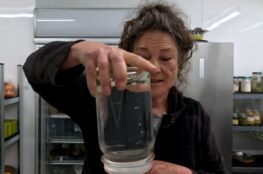
I do love a kitchen gadget. Particularly one that promises to suck all the air out of a jar at the press of a button. Enter the Mason Genie… and all the other little electric Mason jar vacuum sealers that seem to be popping up everywhere.
The concept is simple. Put a flat lid on your jar, pop the vacuum sealer over the top, press the button and it removes air from inside the jar. The lid gets sucked down onto the rim and… ‘pop’ you’ve got yourself a vacuum seal. Very satisfying.
But, particularly here in New Zealand, there’s a rather important catch.
A Mason jar really does mean a Mason jar
We Kiwis are very familiar with Agee preserving jars, branded with their signature Agee ‘Special’ or ‘Utility’ embossing. Over time, with the Americanisation of our language (through advertising, online shopping and social media) we’ve tended to use ‘mason jar’ as a generic term for this style of preserving jar, but they’re not quite the same thing.
Our Agee jars are based on metric capacities (think 500 ml and 1 litre) while American Mason jars are traditionally sized in US fluid ounces, pints and quarts. So what looks like the American equivalent of our 1-litre Agee jar is actually a 32 fl oz Mason jar, holding around 946 ml.
The volume/shape may differ but the the wide-mouth Agee Special and Utility jars use the same 86 mm wide-mouth lid size as the American wide-mouth Mason system. So naturally I thought: Excellent. My Mason Genie should work on my wide-mouth Agee jars. Not necessarily.
It isn’t just the diameter of the opening that matters… it’s the neck of the jar. Which is particularly frustrating when you’re standing there thinking, BUT THE LID FITS!
A standard Mason wide-mouth lid will fit an Agee 1 litre jar or a 500 ml jar but that doesn’t necessarily mean a Mason vacuum-sealing gadget will fit, because the gadget has to fit over more than just the mouth, it has to fit over the neck and shoulder too. The vacuum attachment has to slide down over the lid and the top of the jar far enough to create the vacuum. So this isn’t necessarily about whether a Mason lid fits your jar. It’s whether the whole vacuum attachment fits over the jar properly.
What DOES work for me in NZ terms?
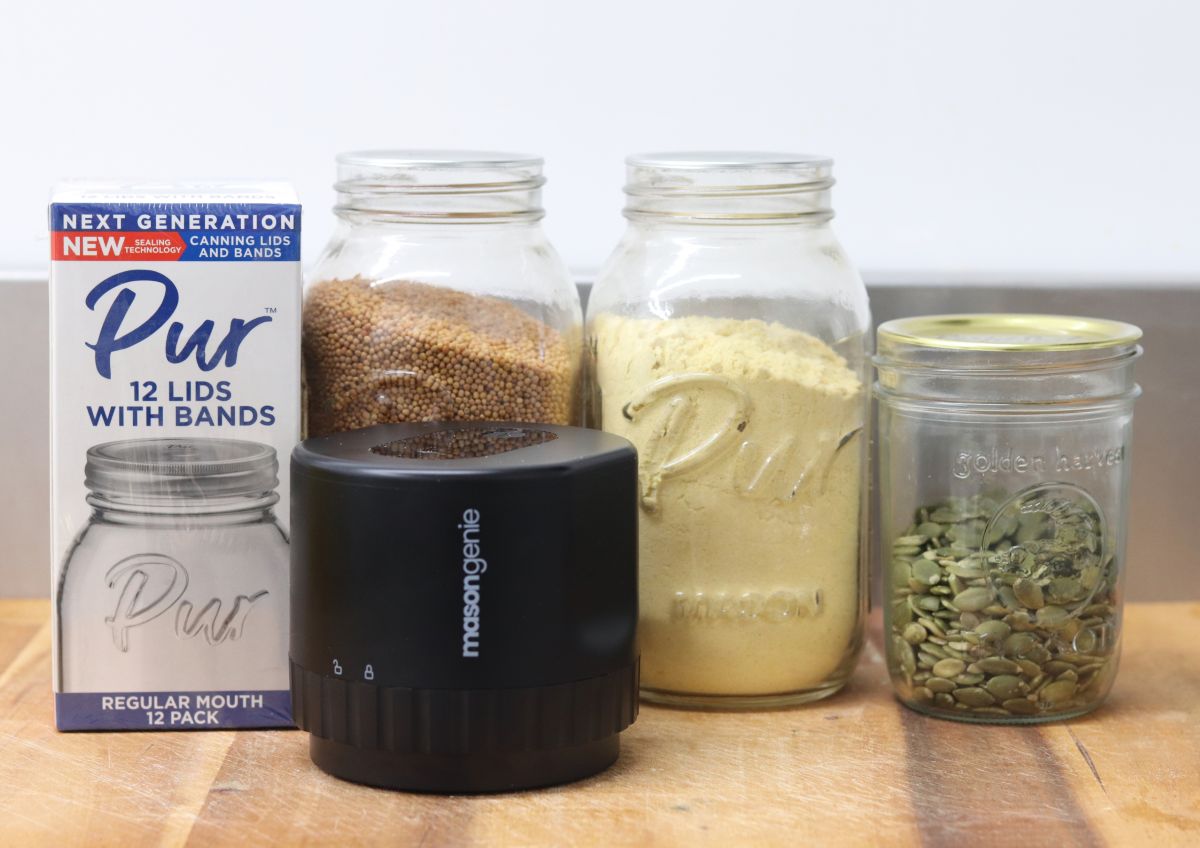
In my experience I’ve had success with Pur regular-mouth Mason jars available in select Mitre10 stores across New Zealand. These jars are 32 oz, or 946 ml (as per the American standard Mason jar). The Mason vacuum sealer has a regular-mouth vacuum attachment that fits them as intended.
For me, that’s where this little gadget earns its place in the kitchen. I can vacuum seal dry goods such as dehydrated fruit and vegetables, herbs, beans, rice and other pantry staples. Remove what I need, put the lid back on and vacuum seal it again. It’s also handy for suitable fresh foods being stored in the refrigerator. Brilliant.
While Mitre10 does stock them, I’ve found that not every store necessarily has them sitting on the shelf. My suggestion? Talk sweetly to your local customer services desk. If another Mitre10 store has the Pur jars you’re after, ask very nicely whether they might be able to bring some in for you. You never know, they may happily oblige.
And if enough of us keep asking for them, who knows? Perhaps more stores will decide there’s enough demand to actually stock them. Consider it a gentle grassroots campaign for better access to Mason jars!
I have also had some random success with the odd Mason jar found in charity shops (Golden Harvest Mason Jar – wide mouth) but these are few and far between.
And, for the record, I did also have random success with one Agee Utility Jar in a moment of sheer fluke, only to have it never repeated in the 30+ attempts that followed.
Vacuum Sealing
Vacuum sealing a jar is NOT the same thing as preserving food by water-bath or pressure canning. That little pop and firmly attached lid can make it feel like you’ve “preserved” something, but you haven’t. A vacuum sealer removes air from the jar and pulls the lid down to create a vacuum. It does not heat-process the food. That’s a very different thing from water-bath preserving or pressure canning.
Water-bath preserving uses heat and is an appropriate tested process for high-acid foods. Pressure canning reaches higher temperatures and is used for appropriate low-acid foods. A Mason Genie (or similar branded/unbranded gadget) does neither.
I’m not going to fill a jar with homemade tomato sauce, vacuum the lid onto it and stick it in the pantry for six months. Likewise, I’m not going to vacuum seal fresh green beans into a jar and assume they’re now preserved. They’re not.
So, is a Mason Genie worth having? For me, yes… as a storage gadget, not a preserving shortcut. I particularly like it for dry and dehydrated foods because once I’ve opened a jar, I can take out what I need and vacuum seal the jar again.
It’s also useful for suitable foods being kept in the fridge rather than endless plastic bags.
But if I want something safely preserved and shelf stable for long-term storage, I’ll still be reaching for my water-bath or pressure canner and following an appropriate preserving method.
And if you’re a fellow Kiwi looking at your Agee wide-mouth jars and thinking, “Surely it’ll fit — the Mason lid fits!…” Yep, that’s exactly what I thought too. Same mouth. Same lid. Different neck. Be forewarned!